Meeting held at Credence, Fremont, CA. September 24
& 25, 1997
Minutes taken by Nathan Biggs, Microchip Technology Inc. <mailto:Nathan.Biggs@Microchip.com>
Summary of Action Items
|
AI |
Description |
Owner (s) |
Status |
|
1 |
Members of STIL committee will contact balloters to see if there are any questions and to encourage early submission of ballots | All | Tony and Greg will divide names |
|
2 |
Meeting notice, and details on the Dec 3-4 ballot review meeting | Dave Dowding | 6 weeks before meeting |
|
3 |
Tony to talk to Greg about expectations for December meeting | Tony Taylor | Greg indicated that would be a good time |
|
4 |
Distribute copies of original STIL SRS (or portion of original) for use as an example | Tony Taylor, Hira Ringa |
Done |
|
5 |
Nathan Biggs to send an HTML version of the Extensions for Simulation proposal to Don Organ for inclusion on the STIL web page. | Nathan Biggs | Done 9/29 |
|
6 |
Investigate conference calls as a way to have group communications between meetings | Tony Taylor | |
|
7 |
Host Wednesday evening STIL meeting at ITC | Francisco Hernandez | |
|
8 |
Frank Peyton will develop a proposal for a STIL parser, and distribute it before the ITC STIL working group meeting | Frank Peyton | |
|
9 |
Review contents of DC Table (aka Resource Table) and put descriptions behind each of the items | Dave Dowding, Ross Youngblood |
|
|
10 |
e-mail ls245 STIL program showing a simulation database example to Tony Taylor | Nathan Biggs | Done 9/29 |
|
11 |
Develop pictures for understanding LTX’s enVision data model | Don Organ | |
|
12 |
Re-distribute original proposal for time-set scramble to the working group (Timing pattern document) | Tony Taylor | Done 9/29 |
Summary of Decisions
|
# |
Description |
Status |
|
1 |
Vote for Thursday ITC working group meeting | 11 Yes (Overridden by # 7) |
|
2 |
Vote for Tues or Wed eve ITC open door STIL show | 11 Yes |
|
3 |
Once ballots are in all STIL efforts will be focused away from 1450A extensions, and on to resolving ballot issues | Unanimous |
|
4 |
Dave Dowding offered to host a ballot review meeting at Microchip in Chandler, AZ on Dec 3-4 1997 | Unanimous |
|
5 |
People interested in 1450B (Analog/Mixed Signal) should organize and take responsibility for meeting. This will be discussed at ITC working meeting. | |
|
6 |
All proposals for parser will be received and reviewed before ITC meeting so that a decision can be made there. | |
|
7 |
Dismiss Thursday ITC STIL meeting so that people can attend the "Economics of Test" workshop where STIL will be discussed | Unanimous |
|
8 |
Wednesday ITC meeting will start early (4:00), and be open door. Then later after the STIL show, there will be a working group meeting to discuss the parser (and perhaps other issues) | Unanimous |
|
9 |
LTX’s enVision data model was a good starting point for developing a program flow, and test method description for STIL | Concensus |
Summary of Priorities for 1450A
|
Priority |
Description |
|
1 |
DUT Environment for a pattern (including simulation and test environments) |
|
2 |
STIL as a Simulation Database for Pattern Generation (Stimulus to EDA) |
|
3 |
Synchronization of external things with STIL (Digital patterns, External processes) |
|
4 |
Flow Control |
|
5 |
Test Methods |
|
6 |
Feedback to EDA |
|
7 |
Tester Targeting |
|
8 |
Tester Rules |
Wednesday Meeting started at 10:00am
Attendees:
| Tony Taylor | TSSI | tonyt@tessi.com | (510) 623-4841 |
| Hira Ranga | Credence Systems | hira_ranga@ca.credence.com | (xxx) xxx-xxxx |
| David Dowding | Microchip | ddowding@microchip.com | (602) 786-7582 |
| Nathan Biggs | Microchip | Nathan.Biggs@microchip.com | (602) 786-7537 |
| Frank Peyton | Contractor | fwp4ictest@worldnet.att.com | (602) 786-4175 |
| Phil Barch | Texas Instruments | pbarch@ti.com | . |
| Gregg Wilder | Texas Instruments | gwilder@asic.sc.ti.com | . |
| Fransisco Hernandez | Texas Instruments | fah@test490.pac.sc.ti.com | . |
| Joe Carbone | Teradyne | joec@ICD.Teradyne.COM | . |
| Don Organ | LTX | organ@ltx-tr.com | (408) 383-2518 |
| Tom Munns | Motorola | tommu@risc.sps.mot.com | (512) 895-2175 |
| Givargis Danialy | Schlumberger | danialy@San-Jose.ate.slb.com | . |
| Gary Murry | LTX | gmurry@ltx-tr.com | . |
| Ernie Wahl | Lucent | wahl@kiwi.micro.lucent.com | . |
| Kevin Fetterly | TSSI | kevinf@tessi.com | . |
| Stefan Zschiegner | Hewlett Packard | stefan_zschiegner@hp.com | . |
Discussion of organization of the meeting:
1. Discussion of meeting plans for ITC. IEEE P1500 has been
formed for embedded core testing. Part of their charter is extensions to
STIL. Want to involve this committee in the discussions of STIL.
Vote for Thursday working group meeting at STIL: 11 yes
Vote for Tuesday or Wednesday STIL show at ITC: 11 yes
There will be further discussion on 9/25 on who will fund
the show, and who will participate.
2. 1450 Ballot Issues
During balloting, there should not be contact with the balloters,
but once they have submitted then there will be some interaction with the
balloters.
Dave Dowding offered Microchip as a November meeting time for a "Ballot Review Meeting".
There was unanimous decision that once the ballots are ready, the effort will switch away from the 1450A extension discussions, and focus on the ballot issues.
Phil Barch volunteered to call some of the balloters to encourage them to submit on time, or ask them if they have any questions. Tony Taylor also agreed that this was a good idea if it is appropriate.
Dave Dowding proposed December 3 and 4 1997 for a ballot issue discussion meeting at Microchip in Chandler.
Kevin Fetterly says there may be concern with Macros in STIL. Tony'’s issue is with the ‘include’ statement and whether you can include partial blocks (i.e., the inclusion of incomplete pattern blocks with an IfNeed statement)
Ernie Wahl wonders about coming up with new microcodes for analog testing. Phil suggests using annotations.
There are different levels of voting:
Another issue, as raised by Dave Dowding, is the need for
the ability to attach user keyword defined statements to a timeexpr in
a waveform statement.
Phil Barch suggests that there may be some of these extension issues that would need to be incorporated into the 1450 standard sooner than what the 1450A would do.
Ernie wants to know about defining null (or empty) signalgroups. Nathan Biggs indicated that the answer is yes according to the BNF.
Tom Munns indicates that there is a big need at Motorola for training and education. Phil Barch also indicated that he and TI are very interested in training. Frank Peyton said that he is developing training as an independent contractor. The goal was to have this done by ITC time, but it may not be done by then.
Tony will talk to Greg on his expectations on a December meeting for resolving balloting. He will also ask Gordon (?) at Credence for talking about his experience with IEEE balloting.
Dave and Phil agreed that it would be very good to call and talk to the balloters to help resolve issues or concerns before they submit their ballots. Tony will ask Greg for the names of the balloters and also find out if it is appropriate to contact these people.
3. Charter for 1450A "Extensions Committee"
Tony will get copies of the original STIL SRS for us to review. Frank said that pages 13-15 would be sufficient for use as an example.
Tom Munns suggests considering 1450A as just a continuation of 1450. Dave Dowding suggests a dual track to work on STIL: Track 1) Wrapping up and finalizing STIL, and Track 2) Extending STIL.
Discussion ensued on how PAR’s are used to define "dot"
additions, or supplements to the language. Further discussion preliminary
to developing a charter for 1450A.
It is proposed to break into functional groups to discuss the three groups. Tony will go through each of the groups, and try to define topics
It was decided that the group would remain together and review the issues as a body, rather than smaller groups.
Phil started a discussion of STIL not knowing the conditions
under which a pattern was created from simulation. Phil wants some way
to specify the environment under which things should be run.
Requirements for environment:
1. DC Levels, Temperature, Loading (put in categories,
and selectors)
2. Define conditions at patexec level (tool that created
the database, simulated temperature, timing, and voltage, and their valid
ranges.
Nathan Biggs indicated that an environment descriptor
was part of the simulation proposal to be made later in this meeting.
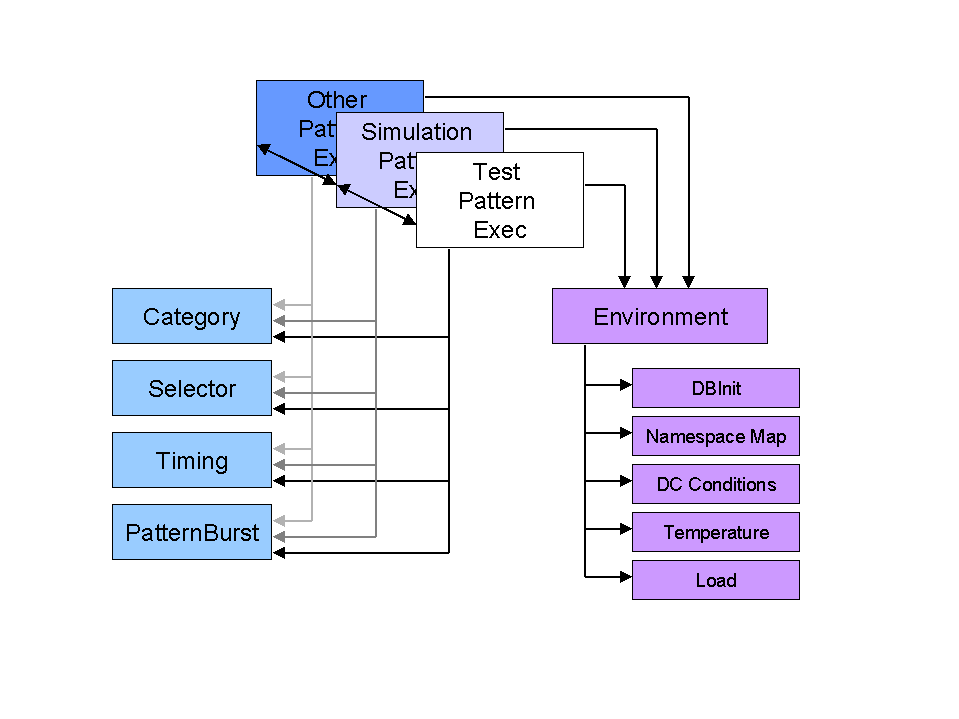
The following diagram (or a variation of this diagram) was drawn to illustrate the need for different pattern exec domains, and how they would reference an "Environment Domain". The environment domain may be contain information for the conditions under which that test was executed (or simulated). There needs to be some reference between pattern exec instances (or perhaps environment domains) so that one domain knows the conditions under which its test was created.
Ernie says that "Test Descriptions" and program flow need to be discussed together.
Need to find out from the different tester vendors whether
they will share their test instances to consider as a standard. Tom Munns
suggested that we need to take STIL to the point that it refers to a native
tester’s test. Then the native (probably optimized) test can be used on
each test platform. (i.e., have STIL say "leakage test" and some
parameters, then the tester native modules. But you may want to specify
a standard so that all suppliers can be measured as to how they meet the
standard. If we get presentations from each of the tester vendors listed
(LTX, Credence, Sclum, IMS, etc.)
Don Organ says that LTX will offer their data model for creating an entire program.
Defining tester limits or restrictions on resources. It may be difficult to define at what level you cut off the tester rules. It may be something that the ATE companies develop and give to their customers for use in simulation, or translation. But it would also need to be user customizable. STIL would have a syntax and a container for rules, but not attempt to dictate what the rules are.
To make STIL usable as a simulation database (in place of HDL, and given the appropriate software tools to communicate STIL to the simulator) there are four areas that need to be extended, or enhanced.
These enhancements would allow STIL to be used as a simulation database. There may also be many other applications for the enhancements.
Don Organ wants an electronic version of the simulation
proposal to put on the web page and to invite comments. Nathan Biggs will
generate HTML version and send it to Don.
9/25 Meeting 8:00am
Attendees:
| Tony Taylor | TSSI | tonyt@tessi.com | (510) 623-4841 |
| Hira Ranga | Credence Systems | hira_ranga@ca.credence.com | (xxx) xxx-xxxx |
| David Dowding | Microchip | ddowding@microchip.com | (602) 786-7582 |
| Nathan Biggs | Microchip | nbiggs@microchip.com | (602) 786-7537 |
| Chris Nelson | Intel | Chris_J_Nelson@ccm.intel.com | |
| Ahsan Imam | Intel | . | . |
| Frank Peyton | Contractor | fwp4ictest@worldnet.att.com | (602) 786-4175 |
| Phil Barch | Texas Instruments | pbarch@ti.com | . |
| Gregg Wilder | Texas Instruments | gwilder@asic.sc.ti.com | . |
| Fransisco Hernandez | Texas Instruments | fah@test490.pac.sc.ti.com | . |
| Joe Carbone | Teradyne | joec@ICD.Teradyne.COM | . |
| Don Organ | LTX | organ@ltx-tr.com | (408) 383-2518 |
| Ross Youngblood | Schlumberger | rossy@San-Jose.ate.slb.com | (541) 714-1754 |
| Tom Munns | Motorola | tommu@risc.sps.mot.com | (512) 895-2175 |
| Givargis Danialy | Schlumberger | danialy@San-Jose.ate.slb.com | . |
| Gary Murry | LTX | gmurry@ltx-tr.com | . |
| Ernie Wahl | Lucent | wahl@kiwi.micro.lucent.com | . |
| Larry Moran | Teradyne | moran@std.teradyne.com | . x7207 |
| Stefan Zschiegner | Hewlett Packard | stefan_zschiegner@hp.com | . |
Proposed 1450A charter from Tony
"Whereas the 1450 STIL project was limited in scope to the development of an interface language for functional patterns for digital devices, the 1450A project is to extend the interface language to define all other aspects of test definition for digital devices.
The language is to be device oriented, to define the function and parameters of test, but not the detail of implementation.
The language is to support:
a. Test stimulus, test intent, test environment, as
defined in design simulation,
b. Test flowand functions performed in characterizing
of digital device
c. Test flow and functions performed in production test
of digital devices
d. Test result data necessary for correlation with the
design stimulus and intent."
Need to discuss process of communicating between meetings:
Conference calls,
E-mail list
Will discuss how to contact balloters for questions. Attendees
are invited to indicate whether they do not want to be involved in contacting
balloters.
Discussion of proposed charter:
Frank does not like the word "all" in "all other aspects of test definition for digital devices". This is too broad of a statement and does not specify and end condition.
Ernie and Phil proposed leaving the word "all"
out.
Move the enumerated list of things to work on up.
The version of the 1450A charter that everyone agreed
on is:
"Whereas the 1450 STIL project was limited in
scope to the development of an interface language for functional patterns
for digital devices, the 1450A project is to extend the interface language
to define other aspects of test definition for digital devices:
"a. Test stimulus, test intent, test environment,
as defined in design simulation,
"b. Test program flow and functions performed in
characterization of digital device
"c. Test program flow and functions performed in
production test of digital devices
"d. Test result data necessary for correlation with
the design stimulus and intent.
"The language is to be device oriented, to define the function and parameters of test, but not the detail of implementation."
Dave Dowding wants to discuss a date for the next meeting.
It is proposed to have a December 3-4, 1997 meeting at Microchip in Chandler.
Dave will post a meeting invitation a few weeks after the minutes are posted.
The December meeting will be a 1450 meeting for reviewing ballot issues.
The ITC meeting will be on 1450A. Is that appropriate? Or should the existing
ballot issues be discussed? It is proposed that the ballot issues take
top priority on the meeting agenda.
What about the analog (1450B) meeting? Tony: we need another
chair person that will take leadership of the B meeting. The people (companies)
interested in mixed-signal need to take this and get it moving. The charter
and forming of the B working group at the Thursday ITC meeting.
We still need to find a host for the Wednesday ITC meeting.
Francisco Hernandez agreed to host the Wednesday ITC meeting.
Issue from agenda to discuss today: STIL Parser:
Tom Munns said that Motorola will probably have the means
to contribute to the development a STIL parser. HP will also fund it, as
well as TSSI. LTX will not do anything until there is a specific proposal
to get signed off.
Tony has proposals from two companies to do a STIL parser:
SAS and Sabre. We need to define the extent of the parser. Will it be a
Lex/Yacc gramar only, or will it include an API and database access?
SAS (Silicon Automation Systems) proposal:
The project:
create a parser for the STIL 1450-0.9 standard
Create an OO data base to hold the data
Perform semantic checking on the data
Provide an API for accessing the data
Create regression test suite
Create user documentation
The Platform:
Solaris2
Sun Ultra Sparc
SparcWorks C++ 4.0.1
Lex/Yacc
FrameMaker
The Schedule:
Start: Oct1997
Alpha release: Mar 16, 1998
Beta release: Mar 30 1998
Final Release: Apr30 1998
The cost:
$144,000 (including 6month support)
plus 10% per year for additional support.
Givargis wants to change the name from "OO Database" to "Class Libraries"
There is a discussion of whether there is a read only
library access, or a read and write API.
First Pass SRS:
LexYacc Parser and syntax check
Does the database persist? (No)
Able to read and write STIL data through API?
Does it include semantic checking or just syntax?
Tony distributed the actual proposal from SAS.
Phil and Greg agree that it should be the read access scope only. Tony has added the addendum to the spec that not all files will be kept in memory. Pattern files may need to be cached.
Tony’s description of SAS: Company in India. 170 engineers
and grow to 320 in next year. Tightly associated with EDA world. Telecommunications,
signal processing, System Design/Tools (verilog, vhdl, simulators, synthesis,
layout...)
Phil wants to know if they would do the tool, and then put
it on the market, rather than have a jointly funded effort.
Frank Peyton wants to investigate doing it from his resources,
and having the software available from within the committee. Frank will
put together a proposal.
There is a discussion on whether we need semantic checking
or just syntax checking. Stefan says that a semantic check is outside the
scope of a standards committee, while Givargis says that semantic checking
is vital to the project. At the minimum we need to check the semantics
that are listed in the STIL spec.
Phil suggests that a joint engineering effort may be desirable,
while Don says that dividing this effort would be difficult.
Ross says that performance is a large consideration. A "world-class" parser is needed to show the benefit of STIL.
Tony: Who is interested in doing this? And who is interested
in funding this? Dave says that this is a 1450 meeting issue, and this
may be put off until the next 1450 meeting. Tony wants to get going.
There are three issues that need to be considered:
Parser, Syntax checking, and Semantic checking
Data structure establishment with STIL output writer
read/write methods in and out of the database and semantic
checking
SRS:
Lex/YACC
Class libraries for reading objects
Able to write full STIL data (but maybe not hierarchical)
Data structures
Semantic checking as defined in STIL spec
Performace of parser
By ITC all existing proposals will be reviewed and a selection will be made.
Dave explains workshop format at ITC, and why it might be important for STIL committee members to be in attendance at the STIL workshop. The workshop is on economics of test/design/manufacturing. Management people will be in attendence at the workshop, and it may be advantageous to have a STIL presence at this discussion.
The proposed Thursday STIL working group meeting will be in conflict with this workshop. It is proposed to dismiss the Thursday meeting. The Wednesday meeting will still be open door, with a proposal review to follow that evening. The vote was unanimous to arrange the meetings this way.
----- review of agenda items ----
Ross wants to expand simulation environment to handle
signal-by-signal environment specification.
Tony wants to focus on pattern related issues for expansion before we go into other areas of test. The pattern related things need to get top priority.
Attendees ranked issues by priority (A = High, B=Medium, C=Low), Each item was then ordered for priority
| DUT environment for a pattern(test, sim) | A | 1 |
| Flow control | B | 4 |
| Test methods | B/c | 5 |
| Tester Rules | C | 8 |
| Tester Targeting | C | 7 |
| Feedback to EDA | Cb | 6 |
| Stimulus to EDA for Pattern Generation | Ab | 2 |
| Synchronization of external things with STIL (digital patterns, external processes) | A-6, B-5, C-2 | 3 |
Brainstorm on each of the top priorities: (what is included)
DUT Environment
There are global things
Temperature
And Per-pin things
And per signal things
Resource Table (aka DC Table) (analogous to WFT)
May want to change DC resources on the fly (between each
vector)
What are the contents of the Resource/DC table? (Changeable on the fly)
Power(s) (device perspective)
Comparator levels (vol/voh)
Drive levels (vil/vih)
Tri-state leakage (ioh/iol)
Load (vil/vih/vref, output impedence per in/out state)
Output Buffer Strength
Clamps (hi/lo)
Calibration points
Guardbands (?)
Process variations
Simulated operation range
Constraints (i.e., limits to the levels)
Characterization information (i.e, Ranges, expected results)
Device modelling (Dave Dowding will get parameter list on
this)
Buffer technology
Temperature
Accuracy
Mode
Somebody needs to take the action of expanding each of
these items and putting some description behind each one. Dave Dowding
and Ross Youngblood will each take a pass at it.
Nathan Biggs rehashed the simulation proposal for the people
that were not involved yesterday. There was some discussion about the rectangular
requirement for parallel patterns.
Nathan will e-mail an ascii file of the example (ls245) to
Tony Taylor for syntax review.
== Chris Nelson and another Intel engineer came in, there
was a review of issues covered so far ==
Discussion of Test Flow and Test Methods
Don Organ has supplied notes for the enVision data model.
He discussed each of the objects in enVision.
Suggests adding the "TesterCh = x;" statement
to map STIL pins to tester resources. There is the notion of "Cbit"
that controls a loadboard. STIL may need the ability to control device
external things.
Line 147 in handout is the first "test block"
There is a question as to how the committee will handle test
methods. Do we define the specific tests and their types, or do we define
"how" a test is constructed, but not how the test is done. Whatever
we do it needs to be extensible, because whatever we do, we will leave
some of the tests out.
Line 251 is the flow object
Don will also come up with some pictures that will relate
some of these objects. There was concensus that this was a good start for
the syntax that we want for flow, and test.
Discussion of Tester Targeting:
Should there be a definition of the order that the tests
should be executed in?
To optimize for given tester
What re-ordering is allowed?
List (ordered) vs. Collection (no order)
Givargis said that the Microchip proposal for timing could be used for tester targeting in timing selection
Chris says that we need to be able to specify the time-set scramble.
Tony says that there is a document with the original proposal
for time-set scramble. He will re-distribute the document.
Other tester specific items:
Channel mapping (mux, multi-site testing)
Calibration (standard, fixture, and focused)
Accuracy (waveform choices, analog)
Resource limits
Number of pins (may be tester rule)
Control bits for external control
EPROM on DUT board for identification
GPIB for instrument control
Power Supply Delays
External Clock
Mux-mode, Doublet, etc.
Match Mode
Pattern functions (Subroutine variable parameters)
All items that fall out of 1450A should be considered
as tester targeting.